April 14, 2026
Antarctica Belongs to Everyone: What Non-Hikers Need to Know
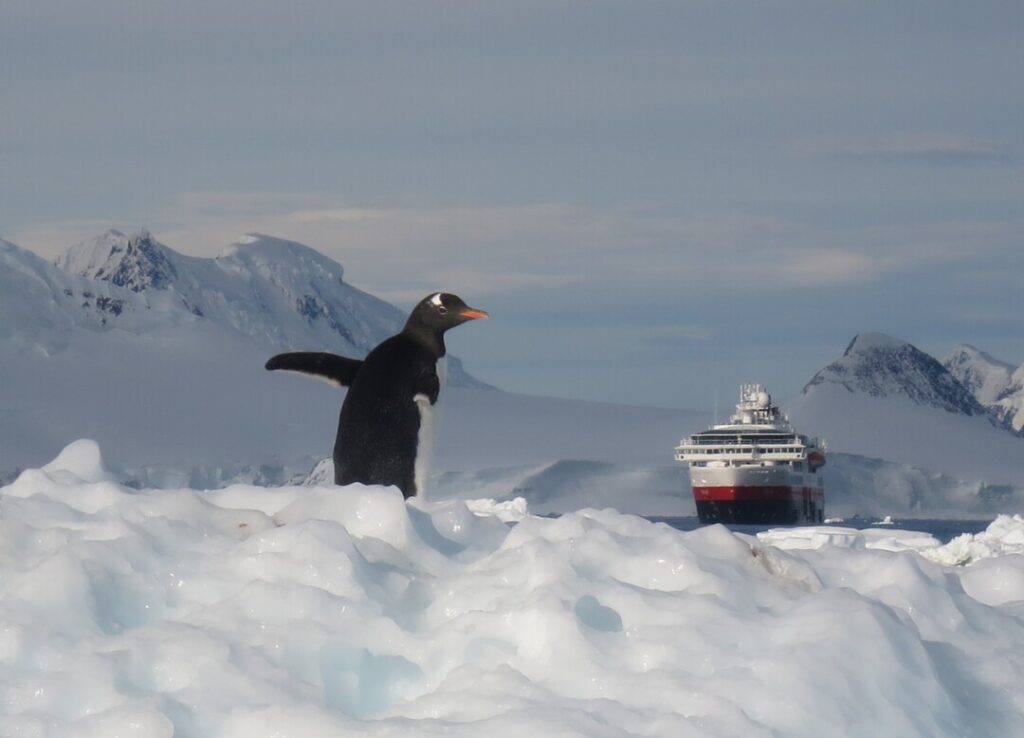
Here is the version of Antarctica most people picture: crampons, extreme cold-weather gear, physical endurance, and a passenger manifest full of people who run ultramarathons for fun. If that image has kept you from seriously considering this trip, it has been doing you a disservice.
Antarctica belongs to everyone. That is not a marketing line. It is the founding principle behind the Antarctic Treaty and the framework that IAATO, the International Association of Antarctica Tour Operators, was built to protect. Antarctica is not owned by any nation. It is not reserved for scientists or adventurers. It is one of the few places on earth that exists, by international agreement, as a commons. Every person who wants to go has a legitimate place there, and an Antarctica expedition cruise is designed to make that possible regardless of your fitness level or mobility.
That includes people who travel in wheelchairs. Operators like HX Expeditions offer accessible cabins, and multiple expedition lines have crew protocols specifically for assisting passengers with limited mobility into Zodiacs and onto the ice. This is not the exception. It is a deliberate part of how modern expedition cruising is designed.
What you need to bring is curiosity. The logistics take care of themselves.
What the Misconception Gets Wrong
Expedition cruising is not adventure travel in the traditional sense. The ship is comfortable. You have a cabin, meals, a lounge, and a schedule. Shore landings are optional, time-limited, and led by experienced naturalists who set the pace. On any given day, a landing runs 90 minutes to two hours. You return to the ship for lunch. Some days there are two landings. Others involve scenic cruising through iceberg channels where no one leaves the ship at all.
The physical requirement for most landings is the ability to board and exit a Zodiac, often with crew assistance, and move slowly on uneven terrain for short distances. Operators brief passengers on site conditions before each landing and give honest assessments of what each location involves. Nothing is required. Passengers with mobility limitations can often still reach the beach and spend time with the wildlife from that vantage point. On days when a landing site is not workable for a specific passenger, staying aboard and watching icebergs the size of city blocks drift past the observation deck is not a consolation prize.
What a Non-Hiker Actually Does All Day
This is the question most people are actually asking when they search for this post. Here is an honest answer.
Under IAATO regulations, no more than 100 people are permitted on the ice at any given time. On ships carrying more than 100 passengers, this means the day runs in rotations. One group goes ashore while another boards Zodiacs for close-water exploration: approaching whale feeding activity, floating in among ice formations, or cruising beneath glacier faces. In the afternoon, the groups typically switch. The morning ice group goes out on the water; the morning Zodiac group heads ashore.
The rotation structure surprised me the first time I understood how it worked in practice. Most people fixate on ice time when they are planning, but the Zodiac experience is genuinely its own thing. Floating at water level next to a whale, or drifting through a channel of sculpted ice in near silence, is not a lesser version of being ashore. For some travelers, it becomes the part of the trip they talk about most.
A friend of mine who has made this crossing multiple times now boards a Zodiac every chance he gets. He comes from a seafaring background, and the water is simply where he wants to be. Most operators will accommodate that preference when there is room, provided no one who hasn’t had their turn that day is being bumped.
The same flexibility applies in the other direction. If conditions allow and there is capacity, most ships will let you request a return to the ice during the Zodiac rotation. The goal, consistently, is for everyone to leave feeling like they got what they came for.
What a Landing Site Actually Looks Like
At a penguin colony, the landing itself is less demanding than people expect. You stand or sit on the beach and watch. The penguins walk past at close range, argue with each other, feed their chicks, and largely ignore you. A naturalist is nearby, but there is no forced pace and no script. Some passengers stay near the Zodiac landing point the entire time. Others wander slowly along the shoreline or find a rock to sit on. If there is room on the ice and you want to hike to a higher vantage point, that option is usually available. If you would rather not, no one is keeping track.
Most expedition lines also offer optional add-on excursions: guided kayaking, snowshoeing, or skiing on select sailings. These count toward the 100-person ice limit but occupy a dedicated group, which can free up additional time or space at the main landing site for everyone else. None are required, and most passengers who book them signed up specifically for that activity.
On any given day, a portion of the ship’s passengers will skip a landing altogether. Some will be in the spa. Others will attend a science lecture or spend time in the onboard Science Centre, which on HX ships is open throughout the voyage. On Lindblad sailings, afternoon conversations with working National Geographic researchers are a regular part of the rhythm. These are not filler activities. They are what happens when you put genuinely curious people in an environment built around one of the most scientifically significant places on earth.
Evenings include dinner, a recap of the day’s observations, and a preview of what is coming. On smaller ships the social dynamic forms quickly and naturally. Antarctica draws a notably well-traveled, curious passenger base, and conversations across the dining room table often become the part of the trip people mention first when they return.
Ship Size Is a Real Decision, Not Just a Preference
When planning an Antarctica expedition cruise, ship size shapes the experience more than any other single variable. This is something I walk through with every person who calls me about Antarctica, because it shapes the experience more than any other single variable.
On a smaller ship, typically under 130 passengers, everyone can go ashore at the same time without triggering the IAATO rotation limit. That means two complete outings per day: a full morning on the ice, lunch aboard, then a full afternoon outing, either back to the same site or a different one. If maximizing time ashore is important to you, a smaller ship is the straightforward answer.
The trade-off is amenities. Smaller expedition ships are built for access and maneuverability, not resort-style comfort. Gym facilities tend to be modest. Spa services may be limited or unavailable. The ship is a base of operations, not a destination in itself. For travelers who know they want to be on the ice or water as much as possible, this is not a loss. For travelers who anticipate spending meaningful time aboard, whether due to weather, mobility, or simply personal preference, a larger ship with more onboard programming and facilities may be the better fit.
Growing up in Wisconsin, I know cold. I also know that after a few hours in Antarctic wind, the idea of a warm lounge and a good lecture has genuine appeal. Neither approach is wrong. The answer depends on an honest read of how you actually travel.
Four Operators Worth Understanding
I work regularly with all four of the lines below. They are not interchangeable, and the differences matter more than most people realize before they start comparing itineraries.
Larger Ships: More Amenities, Rotation Schedule
HX Expeditions is my top recommendation and the starting point for most of my Antarctica conversations. HX is the original expedition cruise line, operating since 1896, and more people have explored Antarctica with them than any other operator. Their ships, the Roald Amundsen and Fridtjof Nansen, are modern, hybrid-powered, and carry up to 490 passengers in Antarctica, making them the largest in this Antarctica expedition cruise category. That size supports more robust onboard amenities and competitive pricing. HX offers accessible cabins and crew trained to assist passengers with limited mobility throughout the voyage. Their Science Centre is open throughout the trip, and a professional photographer documents the entire sailing; the full image archive is included at no extra charge. All meals, drinks, shore excursions, and gratuities are included in the fare.
Smaller Ships: More Ice Time, Fewer Onboard Options
Aurora Expeditions caps their Antarctica ships at 130 passengers. Under the IAATO limit, that means the full group can go ashore simultaneously, producing two complete outings per day rather than a rotation window. Aurora is the better choice for travelers who know they want maximum time on the ice. Their Spirit of Antarctica itinerary runs in partnership with New Scientist, drawing a science-minded passenger base. Onboard amenities are more limited than on larger ships, which is worth factoring in if you anticipate spending significant time aboard.
National Geographic/Lindblad Expeditions is the premium product in this category. Ships carry 126 to 148 passengers, and on some sailings the staff-to-guest ratio approaches 1:1. You travel alongside working NatGeo scientists, photographers, and researchers. The intellectual experience onboard is genuinely hard to match, and pricing reflects that.
Quark Expeditions is a serious polar specialist with one of the most experienced expedition teams in the industry. Their ships in this category carry 138 to 176 passengers. Their classic Antarctic Explorer itinerary is well-structured and competitively priced.
If accessibility is a planning factor, I pull specific cabin specifications and crew assistance protocols from each operator before my clients make any decisions. These details vary by ship and sailing and are worth confirming directly rather than assuming.
Practical Notes Before You Commit
Timing. The timing of your Antarctica expedition cruise matters as much as which ship you choose. The season runs from late October through late March. November and December bring peak wildlife activity: nesting penguins, active colonies, long daylight hours. January and February are warmer. March is quieter with different light and less competition for space on popular sailings.
The Drake Passage. The two-day crossing between Ushuaia, Argentina and the Peninsula is the most variable part of the trip. Conditions range from calm to rough and cannot be predicted in advance. Most people manage with standard motion sickness medication. If you have a history of significant seasickness, this is worth discussing honestly before committing to a sailing.
Gear. Most operators provide waterproof outer layers and rubber boots for landings. You supply warm mid-layers and waterproof gloves. The packing list is more manageable than most people expect.
Lead time. Antarctic sailings sell well in advance, particularly November and December departures. If you are considering the 2026-2027 season, the window for good cabin selection is now. Accessible cabin inventory is limited and goes first.
Solo travelers. Antarctica draws a curious, well-traveled passenger base that tends to be easy to connect with. Several operators offer single-supplement programs or dedicated solo cabin options on select sailings.
If Antarctica has been on your list and the logistics have felt unclear, this is a reasonable place to start the conversation. I work with all four operators listed here and can walk you through specific Antarctica expedition cruise options, accessible cabin availability, and what each ship actually looks like for passengers with varying mobility levels.
When you are ready to dig in, schedule a call here and we can start sorting through what makes sense for your travel style and timing.
You May Also Find These Interesting
- Iceland Cruise: Why They Might Be the Smarter Choice
- Choosing the Best Alaska Cruise for You
- Statement Travel: Adventures That Define You
About the Author
Karen Aikman is the founder of Live LARGE Travel, a Virtuoso-affiliated boutique travel agency. She designs itineraries with thoughtful pacing, smart routing, and a clear-eyed view of what travel actually requires on the ground. She writes regularly about destination intelligence, expedition travel, and planning decisions that hold up once you’re there.
Sharing in more detail our favorite destinations, experiences, itineraries, cruise lines, tips, trends, and all things travel.
Inspiring Spirits
Expanding Horizons
travel tips
Cruise
Travel Inspiration
As a proud Virtuoso advisor, I love having access to some of the world’s most extraordinary adventures. If you're the adventurous type, this issue is for you.
From polar expeditions to jungle escapes, The New Adventures edition of Virtuoso’s magazine is packed with unforgettable travel ideas—and you can have it, free.
Just drop your email below and I’ll send it right over.
Featured Travel Inspiration from Virtuoso