May 19, 2026
Best Time for an African Safari: Kenya vs Tanzania
If you’ve been researching the best time for an African safari, you’ve likely landed on the same question everyone lands on: Kenya or Tanzania? The honest answer is that the question comes too early. Before you choose a country, you need to understand when you’re going, because timing shapes everything, including which country makes more sense, what you’ll actually see, and how crowded your experience will be.
This post walks through what makes the best time for an African safari different depending on your goals, the crowd reality, how the two countries differ on the ground, and what it actually takes to put yourself in position to witness a river crossing rather than just hope for one.
One Ecosystem, Two Countries
Kenya and Tanzania share a single continuous wildlife ecosystem, the Serengeti-Mara, stretching roughly 40,000 square kilometers across the border between the two countries. The wildebeest don’t recognize that border. They move in a clockwise annual loop driven entirely by rainfall and grass, spending time in both countries depending on the month.
The border is relevant to travelers for a different set of reasons: cost, crowd levels, park size, logistics, and how each country has chosen to structure its tourism model. Those differences are significant, and we’ll get to them. But understanding the migration calendar first makes the country choice much clearer.
The Migration Calendar: The Best Time for an African Safari Depends on This
The migration runs year-round. There is no start and no finish. But there are distinct phases, and each one favors a different location.
January through March: The herds are in the southern Serengeti near the Ndutu Plains in Tanzania. This is calving season, with thousands of wildebeest calves born within a compressed window. Predator activity is high because the targets are abundant and vulnerable. This is one of the most underrated times to be in Tanzania: dramatic wildlife action, lush green landscape, and significantly fewer vehicles than peak season.
April through June: The long rains arrive and the herds begin moving north through the central and western Serengeti. Roads in some areas become difficult. This is low season, with sharply reduced prices and very few other travelers. Not the right window for everyone, but worth knowing.
July through October: This is peak season for both countries. The herds push north through the Serengeti toward Kenya, and the famous Mara River crossings begin. Late July marks the start of crossing activity in the northern Serengeti near the Kogatende area. By August and September, herds are moving through both countries, crossing back and forth across the Mara River. October sees the herds begin drifting south again, and Kenya starts emptying out.
November through December: Short rains arrive, the herds return south through Tanzania’s Lobo and Loliondo areas. By December they’re heading back toward the southern Serengeti calving grounds, and the cycle begins again.
Late July: The Case for Doing Both Countries
For travelers asking when is the best time for an African safari that covers both countries, late July is one of the most strategically sound answers.
The Mara River doesn’t run along the Kenya-Tanzania border. It cuts through both countries, which means crossings happen on both sides. In late July, crossing activity is building in the northern Serengeti near Kogatende, on the Tanzania side, before the herds push further into Kenya. A well-structured itinerary starting in northern Tanzania and finishing in Kenya’s Masai Mara puts you at crossing locations in sequence, following the direction the herds are actually moving. You’re not chasing animals going two directions. You’re tracking the same movement through two countries.
A 10 to 12 day trip structured this way can cover northern Serengeti, then cross into the Masai Mara for the second half. This is one of the most complete ways to experience the ecosystem.
Late October and November: A Different Calculation
Late October through November is a different scenario entirely, and doing both countries at that time is a weaker plan.
By late October, the herds are starting their return south into Tanzania. Kenya’s Masai Mara is winding down, and the short rains are arriving. The action has shifted back across the border. If you’re traveling in that window, Tanzania is the clear answer. Northern Tanzania in October and early November, combined with Ngorongoro Crater and Tarangire, gives you strong wildlife viewing as the herds return, at lower prices and with fewer vehicles than peak August. Spending meaningful time in Kenya at the same point is paying migration-season prices for a depleted experience.
The Crossing: What to Expect Honestly
The Mara River crossing is the most requested event in East African safari travel, and it deserves an honest description before you build a trip around it.
There is no schedule. A crossing can happen early in the morning, midday, or not at all for several consecutive days. The herds gather at the riverbank, sometimes for hours, and the deliberating process is genuinely unpredictable. A shift in the wind, a change in water level, one animal committing, and suddenly thousands follow. The crossing itself, when it happens, typically lasts 10 to 20 minutes.
Think of it the way you’d think of the northern lights. You can put yourself in the right place at the right time of year with a knowledgeable guide, and still not see one. The difference from the northern lights is that on a safari, every day you don’t see a crossing, you’re watching lion prides, cheetahs hunting, elephant herds moving, and hundreds of thousands of animals grazing across open plains. The experience is not diminished by the crossing staying quiet. But if a crossing is the single thing you’re building your trip around, you’re setting yourself up for disappointment rather than gratitude.
The practical advice: give yourself as many days near the river as your schedule allows, trust your guide’s intelligence network, and treat the crossing as the best possible bonus rather than the baseline expectation.
Why Tanzania Has Fewer Vehicles
This matters more than most travelers realize before they book.
The Masai Mara covers approximately 1,510 square kilometers. The Serengeti covers approximately 14,750 square kilometers, roughly ten times the size. Tourist density in the Mara during peak season runs significantly higher than in the Serengeti when measured per square kilometer. At the most famous crossing points inside the Masai Mara reserve during August, vehicles can number in the dozens. The image many travelers carry into their planning, alone on the plains with nothing but animals and open sky, is real and achievable, but it requires specific decisions about where you stay and which side of the river you’re on.
Tanzania is more expensive than Kenya, by roughly 20 to 30 percent for comparable itineraries, and intentionally so. Tanzania has structured its tourism model around high-value, lower-volume visitation. The result is a wilderness that still feels like a wilderness. Kenya is more accessible, more affordable, and draws more total visitors into a smaller space. That’s not a criticism of Kenya’s safari experience, which is genuinely excellent. It’s context for understanding what you’re choosing between.
Where You Stay Determines More Than You Think
Camp and reserve selection directly affects your odds of witnessing a crossing, your proximity to the river when one starts, and how your experience compares to the safari you imagined versus the parking lot you’ve seen in viral videos.
In Kenya, the most important distinction is between the main Masai Mara National Reserve and the private conservancies that border it. The major conservancies, Mara North, Olare Motorogi, and Mara Naboisho, operate under strict vehicle limits, allow off-road driving and night game drives (neither permitted inside the main reserve), and offer a fundamentally different quality of game viewing. The conservancies are not fenced, so wildlife moves freely between them and the reserve.
The crossing itself happens inside the main reserve, not the conservancies. The smartest approach for most travelers is a split stay: a few nights in a conservancy for the exclusivity and flexibility, then a few nights in a camp inside or adjacent to the reserve when chasing crossings. Conservancy camps also plug into the same guide radio networks, so when a crossing builds, you can move quickly.
On the Tanzania side, the relevant distinction is between fixed permanent lodges and mobile camps. Several operators run camps that move multiple times per year specifically to stay close to the herd’s current location. Nomad Tanzania’s Serengeti Safari Camp repositions four to five times annually to track the migration. Singita Grumeti operates on a private reserve of over 350,000 acres adjacent to the Serengeti, with its own river frontage and no public vehicle access. Lamai Serengeti, also by Nomad Tanzania, sits a few kilometers from the Mara River in the northern Serengeti with direct access to the Lamai Wedge crossing area.
The guide matters as much as the camp. A guide with a strong radio network and the willingness to try less obvious crossing points, rather than defaulting to the famous locations where vehicles pile up, is the difference between the experience you imagined and the one in those crowd photos.
Beyond the Migration: What Each Country Does Best
Migration timing aside, Kenya and Tanzania have different strengths worth understanding before you decide.
Kenya is more compact and more accessible. The Masai Mara is a short flight from Nairobi, and the park infrastructure is well developed. Samburu National Reserve in the north is home to species found nowhere else in Kenya, including the Grevy’s zebra and reticulated giraffe.
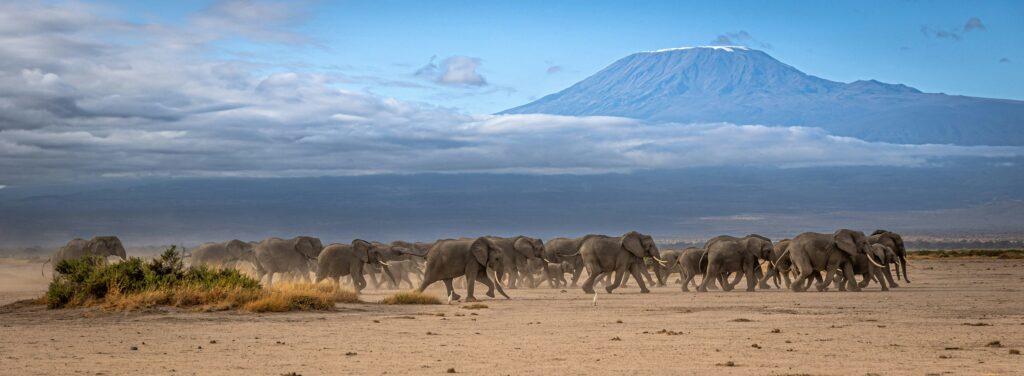
Amboseli National Park deserves specific mention for photographers. Those iconic images of elephant herds crossing open plains with a snow-capped peak on the horizon? That’s Amboseli, in Kenya, looking south toward Tanzania. The mountain itself is entirely in Tanzania, but the flat open geometry of Amboseli’s plains creates the foreground and scale that makes the shot. If you travel to Tanzania expecting to replicate that image, you’ll find yourself too close to the mountain, with forested slopes rather than open savannah in the frame. For the Kilimanjaro-with-wildlife photograph, Kenya is the answer, and Amboseli is the specific park. For a first safari, or a shorter trip, Kenya is often the right starting point.
Tanzania offers scale and diversity that Kenya doesn’t match. The Serengeti’s size means varied ecosystems and wildlife corridors that simply don’t exist in a smaller park. Ngorongoro Crater, a collapsed volcanic caldera and UNESCO World Heritage Site, holds a resident population of all Big Five in a natural enclosure with no equivalent anywhere in Kenya. Tarangire National Park offers elephant herds in the hundreds and a landscape of ancient baobab trees that looks nothing like the Mara plains. Tanzania is also the gateway to Kilimanjaro, Africa’s highest peak at 5,895 meters. For travelers considering combining a summit attempt with a northern circuit safari, that combination deserves its own planning conversation.
The post-safari beach extension also differs. Zanzibar, a short flight from Arusha, is a UNESCO World Heritage island with historic Stone Town, white-sand beaches, and some of the best diving on the East African coast. Kenya’s Diani Beach and Lamu are beautiful and significantly less visited. Both are strong options; which appeals depends on whether you want cultural depth or quiet.
Which Scenario Fits You
The best time for an African safari looks different for everyone. A few honest decision frameworks:
If you have 10 to 14 days and want to follow the migration: Late July, starting in northern Tanzania and finishing in Kenya’s Masai Mara, is the most complete structure. Book a private conservancy camp in Kenya and a well-positioned camp in northern Serengeti on the Tanzania side.
If you have 7 days and want strong wildlife without the crowd question: Tanzania in the dry season, June through October, with northern Serengeti plus Ngorongoro Crater. You won’t have the Masai Mara’s predator density, but you’ll have more space, more variety, and a trip that feels genuinely remote.
If you’re a first-time safari traveler with a shorter window and a tighter budget: Kenya is the practical answer. The Masai Mara delivers reliably, logistics are simpler, and the costs are more accessible.
If the crossing is the priority and crowds are a concern: Position yourself on the Tanzania side of the Mara River, in a mobile or well-located camp in the Kogatende or Lamai area. You’re watching the same river with a fraction of the vehicles.
If photography is a priority: Think about what you actually want to shoot. The Kilimanjaro-with-wildlife image requires Kenya and Amboseli specifically. The widest, emptiest plains with the fewest vehicles in frame require Tanzania. River crossing drama at close range with room to breathe also favors the Tanzania side.
If you’re traveling in January or February: Go to Tanzania. Calving season in the southern Serengeti is one of the most dramatic and underbooked windows in East African safari travel.
A Note on Booking Lead Times
Whatever you determine is the best time for an African safari, peak season camps in both countries book out 12 to 18 months in advance, particularly the private conservancy camps in Kenya and the well-positioned mobile camps in Tanzania. If late July through September is your target window, planning well ahead isn’t optional. The properties that provide the experience described in this post, low vehicle counts, strong guiding, proximity to crossing points, are the first to fill.
If you’re trying to sort out the best time for an African safari, the right country, or both, that’s exactly the kind of planning conversation worth having before you commit to dates. Schedule a call here.
Related Posts
Rovos Rail: The Luxury Train Journey Across Southern Africa
South Africa: Everything Great About Africa in One Flight
African Safari Destination: Botswana
About the Author
Karen Aikman is the founder of Live LARGE Travel, a Virtuoso-affiliated boutique travel agency. She designs itineraries with thoughtful pacing, smart routing, and a clear-eyed view of what travel actually requires on the ground. She writes regularly about destination intelligence, expedition travel, and planning decisions that hold up once you’re there.
Whether you’re dreaming of a bucket-list adventure or a seamless luxury getaway,
click here to schedule a call with Karen and start crafting your next unforgettable journey.
Sharing in more detail our favorite destinations, experiences, itineraries, cruise lines, tips, trends, and all things travel.
Inspiring Spirits
Expanding Horizons
travel tips
Cruise
Travel Inspiration
As a proud Virtuoso advisor, I love having access to some of the world’s most extraordinary adventures. If you're the adventurous type, this issue is for you.
From polar expeditions to jungle escapes, The New Adventures edition of Virtuoso’s magazine is packed with unforgettable travel ideas—and you can have it, free.
Just drop your email below and I’ll send it right over.
Featured Travel Inspiration from Virtuoso